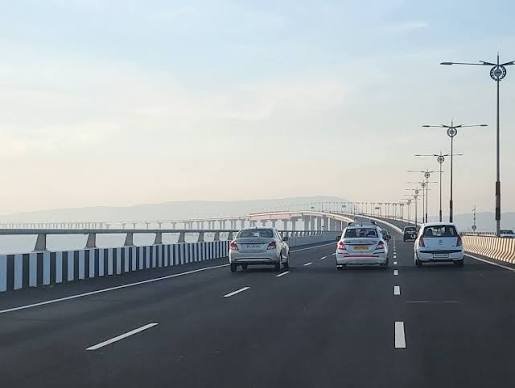
India’s longest sea bridge, officially named the Atal Bihari Vajpayee Sewri-Nhava Sheva Atal Setu, has fundamentally reshaped how Mumbai connects to Navi Mumbai. A journey that once meant a punishing 90-minute crawl through traffic now takes just 20-25 minutes across this 21.8-km engineering marvel — the 12th longest sea bridge in the world, built to withstand over a century of use.
Here’s the complete, current picture of this genuinely transformative piece of infrastructure’s route, toll structure, and practical driving details.
Atal Setu (MTHL) Quick Facts
| Detail | Information |
| Official name | Atal Bihari Vajpayee Sewri-Nhava Sheva Atal Setu |
| Starting point | Sewri, South Mumbai |
| Ending point | Chirle, Uran taluka, Navi Mumbai |
| Total length | 21.8 km (16.5 km over sea, 5.5 km on land) |
| Lanes | 6-lane (3 each direction) |
| Owner | Mumbai Metropolitan Region Development Authority (MMRDA) |
| Construction cost | Approximately ₹17,843 crore |
| Opened | January 12, 2024 |
| Design life | 100+ years |
| Rank | Longest sea bridge in India; 12th longest in the world |
Where the Bridge Begins and Ends
The Atal Setu starts at Sewri in South Mumbai and crosses Thane Creek to reach Chirle in Uran taluka, Navi Mumbai.
Key route facts:
- Total length: 21.8 km
- 5 km runs over the sea, with the remaining 5.5 km on land
- Water depth beneath the bridge reaches up to 47 metres
- 1,089 piers support the structure in water
- Longest single span: 180 metres
Why This Bridge Was Genuinely Necessary
The vision for connecting Mumbai to Navi Mumbai via a direct sea crossing dates back decades, and understanding this history explains why the project carries such significance.
The long road to construction:
- First conceived around 1963 as the “Uran Bridge” proposal
- The broader vision for Navi Mumbai’s development, including this crossing, was formalized roughly three decades before construction began
- Construction finally started April 24, 2018, and completed in December 2023
- Engineering design involved COWI, PADECO, Dar Al-Handasah, and T.Y. Lin International
- Built by a consortium including Larsen & Toubro, IHI Corporation, Daewoo E&C, and Tata Projects
Dramatic Travel Time Improvements
This is genuinely the headline benefit of the bridge, and the numbers reflect a real transformation in how Mumbai and Navi Mumbai connect.
Travel time impact:
- Sewri-to-Navi Mumbai journey reduced from over an hour to just 20-25 minutes
- At the 100 km/h speed limit, the full 21.8-km crossing takes approximately 15-20 minutes
- Significantly reduces travel time toward Pune, Goa, and South India for Mumbai-originating traffic
- Improves connectivity between Mumbai Port and Jawaharlal Nehru Port
Toll Rates: What You’ll Actually Pay in 2026
Toll rates on the Atal Setu have been revised since opening, with a significant government concession currently in place.
Current toll structure (2026, concessional rates through December 31, 2026):
- Car, single trip: ₹250
- Car, return trip: ₹375
- Daily pass (car): ₹625
- Monthly pass (car): calculated as 50× the one-way rate, approximately ₹12,500
- LCV/Mini bus: ₹400 single, ₹600 return
- Bus/2-axle truck: ₹830 single, ₹1,245 return
Important context on these rates:
- These reflect a 50% concession the Maharashtra government has extended through December 31, 2026
- The original 2024 launch rate for cars was ₹250 single/₹375 return — meaning current concessional rates match the original figures after adjustment
- Rates apply at toll plazas on both the Sewri and Chirle sides
Electric Vehicles Travel Completely Free
This is a genuinely significant policy worth highlighting specifically for EV owners.
EV toll exemption:
- Maharashtra government announced complete toll exemption for all electric vehicles on Atal Setu
- Policy effective since August 2025
- Represents a meaningful incentive for EV adoption tied directly to one of the state’s flagship infrastructure projects
- No toll charge applies regardless of trip frequency for qualifying electric vehicles
Vehicle Restrictions and Speed Limits
As a fully access-controlled sea bridge, the Atal Setu enforces specific rules around both permitted vehicle types and driving speeds.
Key restrictions and limits:
- Motorcycles, auto-rickshaws, and tractors are strictly prohibited
- Speed limit: 100 km/h for cars on the main span
- Reduced to 40 km/h on ramps
- Operates 24/7 for all permitted vehicle classes
- No stopping permitted on the bridge itself
Connectivity to Navi Mumbai’s Growth Corridors
Beyond simply crossing the sea, this bridge fundamentally changes access logic for several key Navi Mumbai zones that were previously harder to reach quickly from South Mumbai.
Key connectivity benefits:
- From the Chirle exit, Navi Mumbai International Airport (NMIA) is just 10-15 minutes away via the Chirle-Ulwe road
- Strengthens access to southern corridors including Ulwe, the airport belt, Nhava Sheva, and Dronagiri
- Connects naturally with Eastern Freeway-side access on the Mumbai end
- Particularly valuable for movement tied to South Mumbai combined with Navi Mumbai’s growing residential and commercial zones
Traffic Volume: A Year of Real-World Data
Since opening, the bridge’s actual usage patterns have provided useful insight into how commuters have adopted this new route.
Traffic performance:
- Average daily traffic of approximately 22,689 vehicles recorded one year after opening
- This came in below initial MMRDA estimates, suggesting continued room for growth in adoption
- Designed with capacity for significantly higher volumes as usage patterns mature over time
FAQs
Q1. How much will I actually pay for a round trip on Atal Setu right now?
For a car, expect ₹375 for a same-day return trip under the current concessional rates extended through December 31, 2026. This reflects a 50% government concession on the standard toll structure.
Q2. Do electric vehicles really pay nothing to cross this bridge?
Yes — since August 2025, all electric vehicles are completely exempt from tolls on the Atal Setu, a genuine incentive policy from the Maharashtra government with no trip-frequency limitations.
Q3. Can I ride a motorcycle across Atal Setu to save time?
No — motorcycles, auto-rickshaws, and tractors are strictly prohibited on this bridge. If you’re on a two-wheeler, you’ll need to use an alternate route like the older Sion-Panvel highway or Airoli Bridge crossing.
Q4. How close does Atal Setu actually get me to Navi Mumbai International Airport?
Genuinely close — from the Chirle exit on the Navi Mumbai side, the airport is just 10-15 minutes away via the Chirle-Ulwe road, making this bridge a practical route once the airport becomes fully operational.