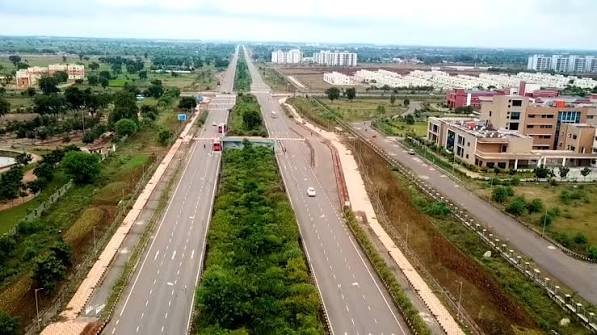
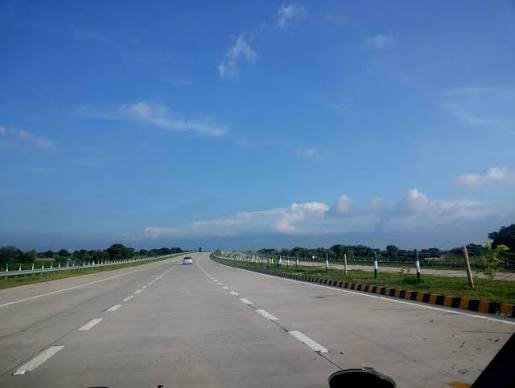
Also known as the Taj Expressway, this 165.5-km corridor connecting Greater Noida to Agra has become one of the most heavily used stretches of road in North India, carrying over 100,000 vehicles daily. It’s turned what used to be a grinding 4-hour drive to the Taj Mahal into a smooth 1 hour 40 minutes, while also becoming a genuine engine for industrial and residential growth along its length — a role that’s only accelerated with the Jewar Airport now under development nearby.
Yamuna Expressway Quick Facts
| Detail | Information |
| Alternative name | Taj Expressway |
| Starting point | Pari Chowk, Greater Noida |
| Ending point | Kuberpur, Agra (NH-19) |
| Total length | 165.5 km |
| Lanes | 6-lane, expandable to 8 |
| Maintained by | Jaypee Infratech Ltd, on behalf of YEIDA, until 2048 |
| Inaugurated | August 9, 2012 |
| Speed limit | 100-120 km/h (cars), 80-100 km/h (trucks/buses) |
| Daily traffic | Over 100,000 vehicles |
| Rank | India’s sixth-longest expressway |
Where the Expressway Begins and Ends
The Yamuna Expressway starts at Pari Chowk in Greater Noida and runs south to Kuberpur near Agra, where it meets NH-19. Along the way, it connects some of western Uttar Pradesh’s most significant towns and emerging development zones.
Key route facts:
- Total length: 165.5 km
- Connects Greater Noida, Jewar, Hathras, Mathura, and Agra
- Reduces Greater Noida-to-Agra travel time from roughly 4 hours to 1 hour 40 minutes
- Made of durable concrete construction designed for sustained high-speed travel
How the Expressway Was Built: Three Phases
Understanding the expressway’s phased construction explains its toll structure and interchange placement even today.
Construction phases (developed by YEIDA, built by Jaypee Infratech):
- Phase I — Greater Noida to the proposed Taj International Aviation Hub near Jewar
- Phase II — Jewar aviation hub area to an intermediate destination toward Agra
- Phase III — Intermediate destination to Agra
This phased structure is also why toll is charged at three distinct points along the route rather than a single flat rate.
The Route Through Western Uttar Pradesh
Leaving Greater Noida, the expressway runs south through Jewar — now closely tied to the upcoming international airport — before continuing toward Hathras district, then Mathura, and finally reaching Agra.
Notable stops and access points:
- Jewar — approximately 40 km from Greater Noida, site of the new international airport development
- Mathura and Vrindavan — dedicated exits provide direct access to these major pilgrimage destinations
- Agra — final destination, connecting to NH-19 near Kuberpur
- 6 interchanges spaced along the full route for regional access
- A patrol station positioned at Tappal, roughly the halfway point (60 km from Noida Sector 37)
Toll Rates: What You’ll Actually Pay
The Yamuna Expressway uses a closed tolling system with three collection points along the route, and FASTag compliance genuinely matters here.
Toll structure (original per-km rates, cars/jeeps):
- Cars and jeeps: approximately ₹2.10/km
- Mini-buses: approximately ₹3.23/km
- Buses and trucks: approximately ₹6.60/km
- Heavy vehicles: approximately ₹10.10/km
- Current one-way toll for a standard car: approximately ₹400-500 (2026 rates)
- Toll collected at three points: roughly 38 km, 95 km, and 150 km from Greater Noida
FASTag rules:
- Mandatory for all vehicles since June 15, 2021
- Without FASTag: double the standard toll rate, plus significantly longer wait times
- Round trip within 24 hours: charged at 1.6 times the one-way toll (e.g., ₹438 one-way becomes ₹700 round trip, instead of the full ₹876 for two separate one-way charges)
Speed Limits and Lane Discipline
Speed regulations on the Yamuna Expressway vary by vehicle type and specific section, with strict enforcement backing them up.
Speed rules:
- Cars: 100-120 km/h depending on the section
- Trucks and buses: 80-100 km/h
- Heavy commercial vehicles: capped as low as 60 km/h in some references
- The rightmost lane is reserved strictly for overtaking, not for sustained high-speed cruising
Advanced Safety Systems
This expressway has invested significantly in monitoring and enforcement technology, particularly following expert safety recommendations implemented in 2025.
Safety infrastructure:
- CCTV surveillance every 5 km along the entire route
- Mobile radar units for speed enforcement
- Highway patrol stationed every 25 km
- RFID-based Electronic Toll Collection across all lanes at each plaza (32-52 lanes per toll plaza)
- All road safety measures recommended by an IIT Delhi expert team were implemented in 2025
Access to Mathura and Vrindavan
For travellers heading specifically to these significant pilgrimage destinations, the expressway offers direct, purpose-built access.
Pilgrimage route details:
- Dedicated exits connect directly toward Mathura and Vrindavan
- Significantly reduces travel time to these destinations compared to older highway routes from Delhi NCR
- A practical option for both day-trip pilgrims and those combining Mathura-Vrindavan with an onward Agra visit
Development Impact Along the Corridor
Beyond its transport function, the Yamuna Expressway has become a genuine catalyst for planned regional development, particularly with major infrastructure projects now underway nearby.
Regional development highlights:
- Provides planned infrastructure for residential, commercial, industrial, and institutional development
- Land development has accelerated significantly with the Jewar Airport (Noida International Airport) now under construction
- YEIDA continues to release residential and commercial plot schemes along the corridor
- A future Metro rail service connecting Pari Chowk to Yamuna Expressway Sectors 18 and 20 has been proposed by officials
FAQs
Q1. How much extra will I pay if I don’t have FASTag on this expressway?
You’ll pay double the standard toll rate, along with facing considerably longer wait times at toll plazas since FASTag lanes move through much faster. Given FASTag has been mandatory since June 2021, arriving without one is a genuinely costly and avoidable mistake.
Q2. Is it cheaper to do a round trip within 24 hours rather than pay two separate one-way tolls?
Yes, meaningfully — a round trip completed within 24 hours costs 1.6 times the one-way toll rather than double. For example, a ₹438 one-way toll becomes a ₹700 round trip rather than ₹876 for two separate one-way charges.
Q3. Can I easily visit Mathura and Vrindavan on my way to Agra using this expressway?
Yes — dedicated exits provide direct access to both destinations, making it genuinely practical to combine a Mathura-Vrindavan pilgrimage stop with your onward journey to Agra without significant detour time.
Q4. How has this expressway changed with the Jewar Airport development nearby?
Land development along the corridor has accelerated significantly since the Jewar Airport (Noida International Airport) construction began, with growing residential, commercial, and industrial interest concentrated particularly around the Jewar stretch, roughly 40 km from Greater Noida.