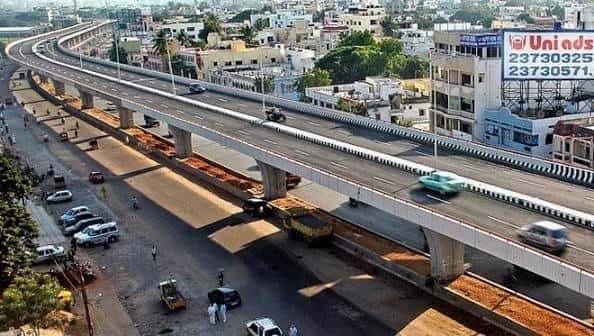
When it opened in October 2009, the P.V. Narasimha Rao Expressway held the title of India’s longest flyover — an 11.6-km elevated corridor named after India’s former Prime Minister, built specifically to give Hyderabad fast, reliable access to its then-new international airport at Shamshabad. More than 15 years later, this elevated road remains one of the few operational expressways in a major Indian metropolitan area that’s still completely toll-free.
Here’s the complete, current picture of this genuinely purpose-built expressway’s route, structure, and the specific rules every Hyderabad traveller should know.
PVNR Expressway Quick Facts
| Detail | Information |
| Full name | P.V. Narasimha Rao Expressway |
| Starting point | Mehdipatnam (near Sarojini Devi Eye Hospital), Hyderabad |
| Ending point | Aramgarh Junction, NH-44 (previously NH-7) |
| Total length | 11.6 km |
| Lanes | 4-lane divided carriageway, elevated |
| Built by | Hyderabad Metropolitan Development Authority (HMDA) |
| Contractor | Simplex Somdatta |
| Inaugurated | October 19, 2009 |
| Project cost | Approximately ₹439-570 crore |
| Toll status | Currently toll-free (proposals discussed but not implemented) |
Where the Expressway Begins and Ends
The PVNR Expressway starts at Mehdipatnam, near Sarojini Devi Eye Hospital in Hyderabad’s core southern city area, and runs to Aramgarh Junction, where it joins NH-44, providing onward connectivity toward Rajiv Gandhi International Airport at Shamshabad.
Key route facts:
- Total length: 11.6 km
- At the time of opening, it was India’s longest flyover/elevated expressway
- Includes a Trumpet Interchange connecting to the international airport approach road
- Features an underpass specifically constructed at Aramgarh Junction
The Route Through South Hyderabad
Leaving Mehdipatnam, the expressway passes through a sequence of significant South Hyderabad localities before reaching Aramgarh Junction.
Areas along the route:
- Mehdipatnam — bustling commercial zone, northern entry point and one of Hyderabad’s most important bus and commercial hubs
- Rethibowli, Laxmi Nagar, Attapur, Hyderguda — mid-corridor residential and commercial stretches
- Upperpally/Upparpally — one of three sharp-turn sections requiring reduced speed
- Rajendra Nagar — large residential colony directly benefiting from mid-expressway ramp access
- Aramgarh Junction — southern terminus, connecting to NH-44 and onward to Shamshabad
Why This Expressway Was Built: Solving Hyderabad’s Airport Access Problem
Understanding the specific problem this corridor solved explains why it remains such a genuinely important piece of Hyderabad’s transport infrastructure.
The core problem it addressed:
- When Hyderabad’s new international airport opened at Shamshabad in 2008, the city needed genuinely fast access from the core city area
- Before this expressway, the journey to the airport could take up to 60 minutes through congested surface roads
- The elevated corridor reduced this significantly, bringing typical airport journey time down to approximately 20 minutes from Mehdipatnam
- Approximately 2,500 vehicles use the expressway daily specifically for airport and Bengaluru-bound travel
Engineering Details Worth Knowing
This expressway represented significant engineering ambition for its time, and understanding its construction specifics helps explain both its capabilities and its restrictions.
Construction specifics:
- Total of 328 foundations, 327 spans, 291 pre-cast slabs, 36 cast-in-site slabs, and 328 piers
- Fully divided carriageway, specifically designed to prevent head-on collisions between opposing traffic directions
- Six midway entry and exit ramps positioned along the route
- Built with full access control, consistent with genuine expressway design standards
Speed Limits: A Genuinely Important Safety Detail
This is worth understanding in specific detail, since the expressway enforces different speed limits at particular points along its length for real safety reasons.
Speed limit structure:
- Standard maximum speed: 60 km/h for light motor vehicles
- Reduced to 40 km/h at three sharp-turn sections: Laxminagar, Upparpally, and Shivrampally
- At these specific points, the carriageway narrows from 7.5 metres to 6 metres, necessitating the reduced limit
- These aren’t arbitrary restrictions — they reflect genuine structural width changes in the road itself
Who Can and Cannot Use This Expressway
Given its elevated, access-controlled design, the PVNR Expressway enforces clear restrictions on vehicle types, consistent with its purpose as a fast-transit corridor.
Vehicle restrictions:
- Cyclists: prohibited
- Two-wheelers: prohibited
- Three-wheelers (auto-rickshaws): prohibited
- Three and four-wheeled seven-seaters: prohibited
- Goods vehicles: prohibited
- Bullock carts and pushcarts: prohibited
- This expressway is designed exclusively for private cars and similar light motor vehicles making the airport or through-city journey
Toll Status: Still Free After More Than 15 Years
This is genuinely distinctive information worth highlighting clearly, since most major Indian expressways of comparable significance have introduced tolling over time.
Current toll situation:
- The PVNR Expressway remains completely toll-free as of the most recent updates (2026)
- Proposals to introduce toll collection have been discussed periodically by HMDA over the years
- No toll has been implemented despite these ongoing discussions
- This makes it one of the few operational expressways in a major Indian metropolitan area that continues to offer free passage
Why This Matters for Daily Airport and City Travel
Beyond its historical significance, this expressway continues to serve a genuinely practical daily function for Hyderabad residents and travellers.
Practical daily impact:
- Provides the fastest available route from South Hyderabad’s core commercial areas toward the airport
- Rajendra Nagar residents specifically benefit from mid-corridor ramp access for both city-centre and airport-direction travel
- Connects seamlessly to NH-44 at Aramgarh, extending practical reach toward Bengaluru-bound traffic as well as the airport
- Remains a critical piece of Hyderabad’s urban transport network despite being over 15 years old
FAQs
Q1. Why does the speed limit drop specifically at Laxminagar, Upparpally, and Shivrampally?
At these three points, the elevated carriageway physically narrows from 7.5 metres to 6 metres, requiring the reduced 40 km/h limit for safety. This isn’t an arbitrary traffic rule — it reflects the actual structural width of the road at these specific sections.
Q2. Can I ride a two-wheeler or auto-rickshaw on the PVNR Expressway to reach the airport faster?
No — two-wheelers, three-wheelers (auto-rickshaws), and several other vehicle categories including goods vehicles are strictly prohibited on this expressway. It’s designed exclusively for private cars and similar light motor vehicles.
Q3. Is the PVNR Expressway really still toll-free, or has that changed recently?
As of the most recent updates in 2026, it remains genuinely toll-free. HMDA has periodically discussed introducing tolling over the years, but no such system has been implemented, making this a notable exception among major Indian urban expressways.
Q4. How much time does this expressway actually save for airport travel from Mehdipatnam?
The elevated corridor reduces the Mehdipatnam-to-airport-direction journey to approximately 20 minutes, compared to what used to be roughly 60 minutes via congested surface roads before the expressway opened in 2009.