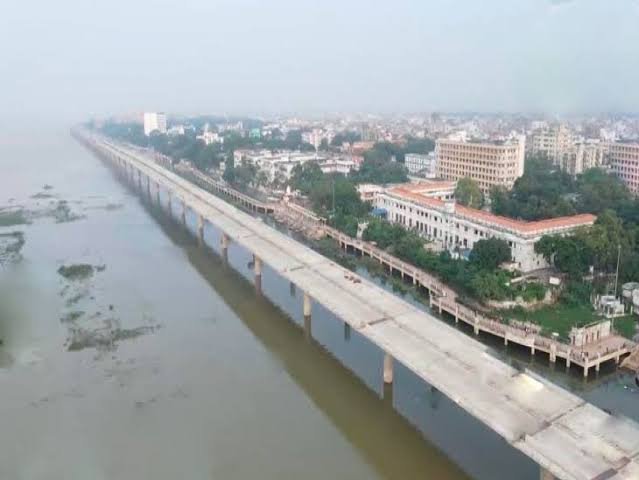
Inspired by Mumbai’s iconic Marine Drive and drawing comparisons to London’s Thames Path, the Loknayak Ganga Path has genuinely transformed how Patna connects along the Ganges. This 20.5-23 km, four-lane expressway runs along the river’s southern bank on a 13-metre-high embankment, offering the dual promise of easing chronic east-west traffic congestion while giving Bihar’s capital a genuine riverfront destination for the first time.
Here’s the complete, current picture of this ambitious project’s route, phased development, and what it means for Patna’s daily commuters and visitors alike.
Loknayak Ganga Path Quick Facts
| Detail | Information |
| Also known as | JP Ganga Path, Patna Marine Drive |
| Starting point | Digha, near Digha-Sone Bridge |
| Ending point | Deedarganj (also spelled Didarganj) |
| Total length | 20.5-23.04 km (sources vary) |
| Lanes | 4-lane, access-controlled |
| Jointly built by | Housing and Urban Development Corporation (HUDCO) and Government of Bihar |
| Total project cost | Approximately ₹3,106 crore |
| Phase 1 opened | June 24, 2022 |
| Phase 2 opened | August 14, 2023 |
| Toll status | Planned as a toll road |
Where the Expressway Begins and Ends
The Loknayak Ganga Path runs from Digha in the west to Deedarganj in the east, tracing the southern bank of the Ganga River through Patna’s urban core.
Key route facts:
- Total length: approximately 20.5-23.04 km, depending on measurement and phase inclusion
- Passes significant landmarks including Patna Medical College and Hospital (PMCH), Gai Ghat, and Kangan Ghat
- Connects to major bridges: Digha Rail Bridge, Mahatma Gandhi Setu, and Kacchi Dargah-Bidupur Bridge
- Nine connection points link the expressway to Ashok Rajpath, Patna’s historically congested main artery
Why This Expressway Was Built
Patna’s chronic east-west traffic congestion, particularly along Ashok Rajpath, created a genuine need for an alternative corridor — and this project was specifically designed to address that gap.
Core objectives:
- Ensure smooth traffic flow between east and west Patna
- Ease congestion specifically at Ashok Rajpath, the city’s historically overburdened main road
- Provide Patna with a genuine riverfront destination, similar to Mumbai’s Marine Drive
- Boost economic activity and tourism along the Ganges riverside
- Address the broader gap between government promises of easy Patna access and the reality of severe internal city traffic
The Route Along the Ganges
Starting near the Digha-Sone Bridge, the expressway proceeds eastward, closely tracing the river’s southern bank before reaching its terminus.
Notable stops and landmarks along the route:
- Digha — starting point, near Digha-Sone Bridge
- Patna Medical College and Hospital (PMCH) — major landmark en route
- Gai Ghat and Kangan Ghat — riverside ghats along the corridor
- Gandhi Ghat — significant cultural landmark
- Deedarganj/Didarganj — original eastern terminus
- Fatuha extension — Phase 2’s further eastward extension, reaching a crucial industrial area 24 km east of Patna
Phased Development: What’s Actually Open
Understanding this project’s phased rollout helps clarify what’s genuinely operational today versus what remains under construction.
Phase-by-phase status:
- Phase 1 — opened June 24, 2022, connecting Digha to AN Sinha Institute; inaugurated by Bihar CM Nitish Kumar
- Phase 2 — opened August 14, 2023, extending 18 km further to Fatuha, reaching the industrial zone east of Patna
- Phase 3 — currently functional as of the latest updates
- Phase 4 — under construction
Real, Measurable Time Savings
This project has already delivered concrete, quantifiable benefits for Patna commuters even before full completion.
Documented benefits:
- Shortens the Digha-to-PMCH journey by 15-20 minutes
- Provides a direct alternative route bypassing Ashok Rajpath’s chronic congestion
- Connects seamlessly with existing infrastructure like the Digha-Sone Bridge for cross-river access
A Genuine Riverfront Development, Not Just a Road
Beyond its transport function, this project incorporates significant public riverfront infrastructure that distinguishes it from an ordinary highway project.
Riverfront development components:
- Part of the broader National Ganga River Basin Authority project framework
- Planned 4.5-km riverfront promenade along the Ganges
- 20 ghats developed along a 2.3-km promenade section, with four cultural centres
- By August 2017, 14 ghats had already been completed as part of this broader riverfront vision
- Specific esplanade stretches planned: Collectorate Ghat to Adalat Ghat (470m), Adalat Ghat to Gandhi Ghat (1,132m), Gandhi Ghat to Rani Ghat (384m), and Bhadra Ghat to Nauzar Ghat (330m)
Funding Structure
This project’s financing reflects a genuine joint effort between state government priorities and central financing institutions.
Funding breakdown:
- HUDCO provided loan financing at a floating interest rate of 10.75%, repayable over 16 years following project completion
- Of the total budget, approximately ₹2,770 crore allocated for road construction and elevation work
- Approximately ₹390 crore allocated for land acquisition and utility shifting
- Total project cost: approximately ₹3,106 crore
Toll Status
Given its scale and the significant infrastructure investment involved, the Loknayak Ganga Path has been planned specifically as a toll road.
Toll considerations:
- Officially designated to operate as a toll road
- Specific toll rate details and collection points continue to be finalized as later phases progress toward completion
- Given the project’s substantial public investment, tolling is intended to support ongoing maintenance and loan repayment obligations
Why This Matters for Patna’s Real Estate and Tourism
Given the dual nature of this project — transport infrastructure plus genuine riverfront destination — its impact extends meaningfully beyond simple traffic relief.
Broader impact:
- Has provided a measurable realty boost along the corridor since Phase 1 and 2 opened
- Offers scenic Ganges views alongside modern infrastructure, drawing both residents and tourists
- Provides convenient access to nearby attractions including Gandhi Ghat, Golghar, and Patna Sahib
- Early morning or late evening visits are recommended for the most pleasant weather and views along this stretch
FAQs
Q1. Is the entire Loknayak Ganga Path currently open, or are sections still under construction?
Phase 1 through Phase 3 are currently functional, connecting Digha through to the Fatuha extension. Phase 4 remains under construction, so check current status for the eastern-most stretches if your journey extends beyond the currently operational sections.
Q2. How much time does this expressway actually save for Patna commuters?
It shortens the Digha-to-PMCH journey by 15-20 minutes, providing a genuine alternative to the congested Ashok Rajpath route that previously forced most east-west Patna traffic through the city’s most heavily trafficked corridor.
Q3. Will I need to pay toll to use this expressway?
Yes — it’s officially planned as a toll road, though specific rates and full collection point details continue to be finalized as later phases near completion. Check current Bihar government or HUDCO announcements for the latest toll structure before travelling.
Q4. Is this really comparable to Mumbai’s Marine Drive, or just a regular highway with a scenic name?
It’s a genuine dual-purpose project — beyond the four-lane access-controlled highway itself, it includes a planned 4.5-km riverfront promenade with 20 ghats and four cultural centres, offering real public riverfront space alongside the transport function, much like its Mumbai namesake.