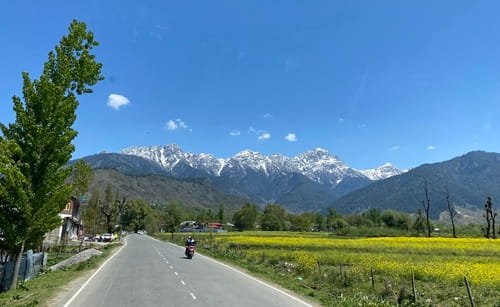
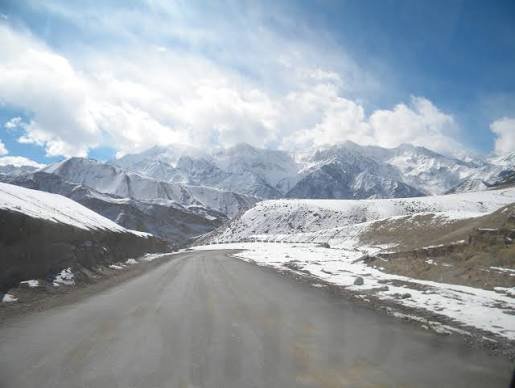
Snow-capped passes, a single-lane mountain road with sheer drops, and a route so strategically important it’s maintained not by NHAI but by the Border Roads Organisation — NH 1 is unlike any other highway on this list. Running roughly 534 km from Uri near the Line of Control to Leh in Ladakh, it passes through Baramulla, Srinagar, and Kargil, crossing three high-altitude passes along the way. This isn’t a highway you drive for convenience; it’s one you drive for the experience, and increasingly, for strategic year-round connectivity to Ladakh.
If you’re planning this route or just want accurate details on its length, road conditions, and rules, here’s the complete picture.
NH 1 Quick Facts
| Detail | Information |
| Starting point | Near Uri / Hattian Bala, Jammu & Kashmir |
| Ending point | Leh, Ladakh |
| Total length | Approximately 534 km (the commonly cited Srinagar-to-Leh stretch alone is 434 km) |
| Region covered | Jammu & Kashmir and Ladakh (Union Territories) |
| Maintained by | Border Roads Organisation (BRO) |
| Mountain passes crossed | Zoji La (3,528 m), Namika La (3,815 m), Fotu La (4,108 m) |
| Formed from | Old NH 1A and NH 1D, merged under current numbering |
| Typical travel time | 2 days minimum (Srinagar to Leh), with an overnight halt at Kargil |
| Seasonal opening | Late March-April to around November-December; Zoji La stretch weather-dependent |
| Speed limit | Generally low and variable — mountain terrain overrides standard highway limits |
Where NH 1 Starts and Ends
NH 1 begins near Uri, a town close to the Line of Control in Jammu & Kashmir, and runs through Baramulla and Srinagar before climbing into the Himalayas toward Leh in Ladakh. This makes it one of the very few Indian highways that connects two separate Union Territories directly through some of the country’s most challenging terrain.
It’s worth noting that most travel guides and popular references focus specifically on the Srinagar-to-Leh stretch — about 434 km — since that’s the portion most travellers actually drive. The full NH 1 designation extends further west toward Uri, adding roughly another 100 km to the total official length.
The Route: Kashmir Valley to the Ladakh Plateau
From the Uri-Baramulla stretch, the highway reaches Srinagar, where most Ladakh-bound journeys effectively begin for tourists and travellers. From Srinagar, the road passes through Sonamarg — a scenic meadow town and the last major fuel stop before a long, remote stretch — before climbing to Zoji La, the first and most demanding of the three passes.
Zoji La, at 3,528 metres, is genuinely the toughest section of this entire highway: a narrow, winding stretch with sharp bends and, in many sections, no guardrails. Traffic here is typically regulated in one-direction convoys during peak season to manage the limited road width safely.
Beyond Zoji La, the highway descends into Drass — the second coldest inhabited place on Earth, with winter temperatures dropping below -40°C — and continues to Kargil, the standard overnight halt point roughly 202 km from Srinagar. From Kargil, the route continues through Namika La and Fotu La, the two remaining high passes, before descending into the Indus Valley and reaching Leh.
Why the Zoji La Section Matters So Much
This single stretch — roughly 10 to 15 km through Zoji La — defines the entire highway’s reputation. It’s the reason NH 1 is closed for months each winter, the reason convoys and traffic timing exist, and the reason travellers are strongly advised to break their journey at Kargil rather than attempting Srinagar to Leh in one exhausting push.
There’s genuinely significant infrastructure work underway to change this. The Z-Morh Tunnel, connecting Gagangir to Sonamarg, became fully operational in January 2025, already improving safety and travel time on the approach to Zoji La. More significantly, the Zoji La Tunnel itself — a 14.15-km bypass that will eliminate the dangerous pass entirely — reached a major excavation breakthrough in June 2026, with full completion targeted for February 2028. Once finished, this will make NH 1 a genuinely year-round route to Ladakh for the first time in its history, rather than a seasonal one.
Speed Limits and Driving Conditions
Standard national highway speed limits don’t really apply in any meaningful sense on most of NH 1. This is mountain terrain maintained by BRO specifically because of its difficulty — narrow single-lane sections, hairpin bends, loose gravel patches, and altitude-related driving challenges mean that safe speeds are often a fraction of what’s technically permitted elsewhere. The Indus Valley stretch from Upshi to Leh is the one genuinely smooth, faster section of the entire route.
Rather than watching a speedometer, drivers on this highway need to watch road surface, weather, and convoy timing at Zoji La specifically — local traffic police and BRO personnel actively manage traffic flow through the most dangerous sections, and following their instructions matters more than any posted speed limit.
Challan Rules and Permits
Standard Motor Vehicles Act traffic fine structures technically apply here as elsewhere in India, but the more relevant regulatory concern on NH 1 isn’t overspeeding — it’s permits and checkpoints. Indian nationals need no permit to drive this route and stay in Leh itself. Foreign nationals require an Inner Line Permit, obtainable online in advance. For onward travel beyond Leh to areas like Pangong Lake, Nubra Valley, or Tso Moriri, all travellers — Indian and foreign — need an additional Inner Line Permit, typically obtained on arrival in Leh.
Given the highway’s proximity to the Line of Control and its strategic military significance, expect multiple checkposts along the route where photo identification is routinely checked. Carrying valid ID at all times isn’t optional on this stretch.
FAQs
Q1. When does NH 1 typically open for the season, and can I check current status before travelling?
The Srinagar-Leh stretch generally opens between late March and mid-April each year, based on snow clearance by BRO, though this can shift by one to two weeks depending on winter severity. Always check current J&K Traffic Police or BRO advisories the morning of departure rather than relying on general seasonal dates.
Q2. Should I attempt Srinagar to Leh in a single day?
It’s technically possible at around 12 hours of driving, but it’s not recommended. Skipping the Kargil overnight halt means arriving in Leh, at roughly 11,500 feet, without any altitude acclimatization — significantly raising the risk of Acute Mountain Sickness. The two-day structure with a Kargil halt exists specifically to protect against this.
Q3. Will the new Zoji La tunnel change how NH 1 works once it’s finished?
Yes, substantially. Once complete — targeted for February 2028 — the tunnel will bypass the most dangerous and weather-dependent section of the route entirely, likely making NH 1 accessible year-round rather than seasonally, as it has been throughout its history.
Q4. Do I need any special permit just to drive from Srinagar to Leh?
Indian nationals need no special permit for this stretch itself. Foreign nationals need an Inner Line Permit for the Srinagar-Leh route, available online in advance. Permits become necessary for everyone, regardless of nationality, only if you’re continuing on to restricted areas like Pangong Lake or Nubra Valley beyond Leh.