Sand dunes to sugarcane fields — that’s essentially what NH 11 covers, running 848 km from Jaisalmer, deep in Rajasthan’s Thar Desert, to Rewari in Haryana’s agricultural belt. It’s the longest highway within Rajasthan itself, threading through the Shekhawati region’s painted havelis, Bikaner’s fort country, and some of the state’s most historically rich towns before crossing into Haryana.
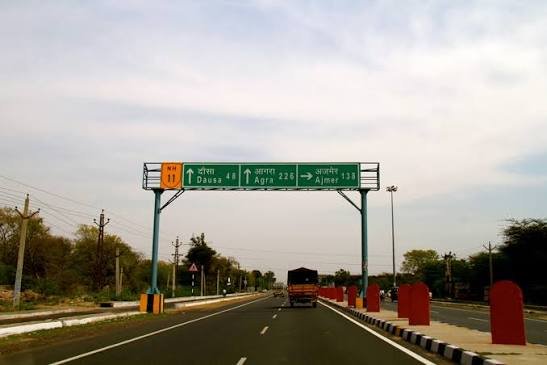
NH 11 Quick Facts
| Detail | Information |
| Starting point | Near Myajlar/Jaisalmer, Rajasthan |
| Ending point | Rewari, Haryana |
| Total length | Approximately 848 km |
| State-wise split | Around 760 km in Rajasthan, remainder in Haryana |
| States covered | 2 — Rajasthan, Haryana |
| Notable fact | Longest national highway running through Rajasthan |
| Maintained by | National Highways Authority of India (NHAI) |
| Development program | Widened and modernized under Bharatmala Pariyojana |
| Major towns linked | Bikaner, Fatehpur, Jhunjhunu, Narnaul |
| Speed limit | 100 km/h (cars), 80 km/h (buses/medium goods), 60 km/h (heavy vehicles) |
Where NH 11 Begins and Ends
NH 11 starts near Myajlar, close to Jaisalmer in the far western reaches of Rajasthan’s Thar Desert, and terminates at Rewari in Haryana, at its junction with NH 48. That’s a journey from one of India’s most remote desert regions — close enough to the Indo-Pak border that the terrain and culture shift noticeably — all the way to Haryana’s more developed agricultural and industrial belt near Delhi’s periphery.
Given its length within Rajasthan alone, NH 11 holds the distinction of being the longest national highway running through the state, a fact that says a lot about how central this corridor is to Rajasthan’s internal connectivity, not just its links to neighbouring states.
The Route Through the Desert and Beyond
Leaving the Jaisalmer area, NH 11 passes through Pokaran — a town known for both its historical fort and its association with India’s nuclear test site — before continuing to Phalodi and Bap. This early stretch cuts directly through Thar Desert terrain, meaning sparse settlements, long uninterrupted drives, and genuine desert driving conditions including periodic sand accumulation on the road surface.
From here, the highway reaches Bikaner, a major desert city known for its forts and camel research centre, before continuing through Sri Dungargarh, Rajaldesar, and Ratangarh. The route then enters the Shekhawati region via Fatehpur and Mandawa — an area celebrated for its elaborately painted havelis and frescoed architecture, making this stretch as much a heritage trail as a transit route.
Continuing through Jhunjhunu, Chirawa, and Singhana, NH 11 crosses into Haryana near Narnaul, passing through Ateli and reaching its terminus at Rewari.
The Shekhawati Stretch: More Than Just a Pass-Through
Worth calling out specifically because it distinguishes NH 11 from many other long desert highways: the Shekhawati region this route passes through isn’t just scenery to drive past. Towns like Mandawa and Jhunjhunu are genuine heritage destinations, known for centuries-old havelis with elaborate wall paintings that draw dedicated heritage tourism separate from the highway’s role as a transit corridor.
For anyone planning this drive with time to spare, breaking the journey to explore this stretch adds real value beyond simply covering distance — it’s one of the more culturally distinctive sections among India’s long-haul highways.
Desert Driving Considerations
The western Rajasthan stretch of NH 11, particularly around Jaisalmer, Pokaran, and Bap, involves genuine desert driving conditions that differ from typical highway travel. Sand accumulation on the road surface during dry, windy periods can affect traction and visibility, and settlements are sparse enough that fuel and rest stop planning matters more here than on busier corridors.
Extreme summer heat is also a real factor — daytime temperatures in this stretch can make midday driving genuinely uncomfortable and occasionally risky for vehicle overheating, so many long-distance travellers on this route plan around early morning or evening driving windows during peak summer months.
Speed Limits on NH 11
Standard national highway limits apply — up to 100 km/h for cars, 80 km/h for buses and medium goods vehicles, and 60 km/h for heavy vehicles including trucks. On the long, straight desert stretches near Jaisalmer and Bikaner, these limits are often genuinely achievable given the flat, open terrain — a contrast to hill highways where posted limits are largely theoretical.
That said, local guidance specifically flags using headlights even during daytime on this highway, along with maintaining safe following distances, particularly given the long sightlines that can lead to complacency at higher desert speeds.
Challan Rules Along NH 11
Standard Motor Vehicles Act penalties apply across both Rajasthan and Haryana, with overspeeding fines typically in the ₹1,000-₹4,000 range depending on vehicle category. Both states set their own specific rates within the central framework, so amounts may differ slightly between the Rajasthan and Haryana portions of the route.
Given the highway’s ongoing modernization under Bharatmala Pariyojana, CCTV and camera-based enforcement has expanded considerably on the more developed stretches in recent years — a shift from the historically lighter enforcement this remote corridor once saw. Assuming minimal monitoring on the desert sections isn’t a safe bet anymore.
FAQs
Q1. Is the Jaisalmer-to-Bikaner stretch of NH 11 safe for driving at night?
It’s generally passable, but the remote, sparsely populated nature of this desert stretch means limited assistance if something goes wrong. Daytime travel is preferable when possible, and if night driving is necessary, ensuring your vehicle is well-fuelled and in good condition beforehand matters more here than on busier highways.
Q2. What’s the best time of year to drive NH 11 through the Thar Desert sections?
Winter months, roughly October through February, offer far more comfortable driving conditions than peak summer, when daytime temperatures in the Jaisalmer-Bikaner stretch can become genuinely punishing. If summer travel is unavoidable, plan around early morning or evening driving windows.
Q3. Can I combine a Shekhawati heritage visit with a regular NH 11 road trip?
Yes, and it’s genuinely worth doing. Mandawa and Jhunjhunu sit directly on the highway route, so a planned stop to see the painted havelis adds minimal detour time while offering a meaningful cultural experience distinct from simply transiting the route.
Q4. Why is NH 11’s length split so unevenly between Rajasthan and Haryana?
Rajasthan is simply a much larger state geographically, and the highway’s core purpose is connecting the state’s remote western desert region to its eastern edge and onward to Haryana. The roughly 760 km within Rajasthan versus the shorter Haryana stretch reflects that geographic reality rather than any administrative quirk.